The answer
The AEO Influence Chain is a model of how AI engines decide which vendors to name. It has 19 signals in four layers: semantic clarity, contextual relevance, validation strength and citation mechanics. A weak signal weakens the whole chain. Most companies are visible to AI but not recommended, and the fix starts with the root cause.
Watch the session
Chapters 14
- Welcome and introductions
- B2B research now starts in AI chat
- AI picks the shortlist before buyers reach you
- Why AI engines reward trust over paid reach
- Most AEO tools show what, not why
- Case study: visible but not recommended
- The 19 signals of the AEO Influence Chain
- Four layers: understand, relevant, validate, cite
- Recency: 46% versus 30% of content
- Demand evidence for the why
- The corporate graveyard of invisibility
- Real buyer intent versus guessed intent
- ChatGPT ads and paid AI discovery
- Wrap-up and what comes next
What is the AEO Influence Chain?
The AEO Influence Chain is a model of the 19 signals that AI engines use to decide which vendors to name, recommend and cite. AEO is short for answer engine optimization. AEO is the work that makes an AI answer engine, such as ChatGPT or Gemini, name your company.
Scott Hebner is Principal AI Analyst at theCUBE Research. He built the model over more than nine months of analysis. He then tested it with ChatGPT, Claude, Grok and Gemini. All four agreed that the model shows how they pick who to surface.
The 19 signals group into four layers. Each layer asks one question about your company.
| Layer | The question the AI engine asks | What it looks at |
|---|---|---|
| Semantic clarity | Do I understand you? | What you offer and why you matter. Whether your messaging is the same everywhere it lives. |
| Contextual relevance | Are you relevant to this question? | How well your content matches real buyer intent, and how recent it is. |
| Validation strength | Can I trust you? | Third-party proof that you are credible, authentic, authoritative and trusted. |
| Citation mechanics | Can I cite you? | Whether crawlers can find, read and quote your evidence. This includes schema and page structure. |
Scott calls it a chain for a reason. If one signal is weak, the whole chain is weak. Michelle Killebrew, founder of Pegasus Strategy Co., added a plain point: your positioning must live in your messaging, not in a file on a shelf.
Why does AI search change how B2B buyers find vendors?
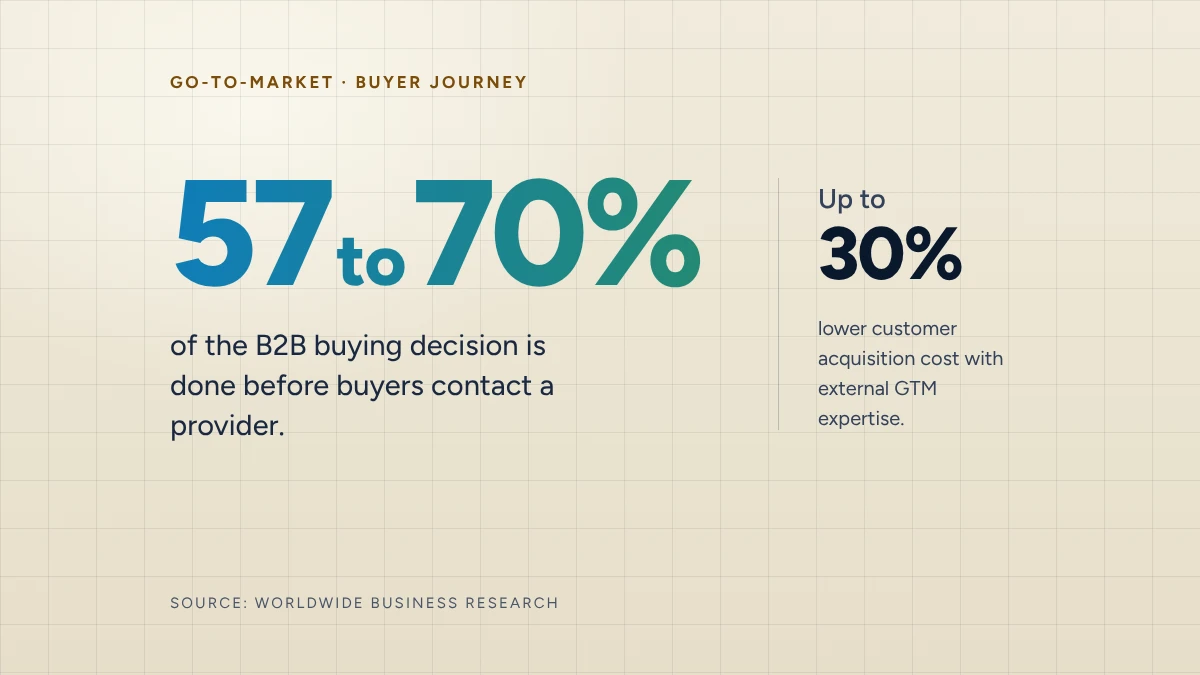
B2B buyers now build their shortlist inside an AI chat, before they talk to any seller. Michelle cited a G2 AI Insights study from February 2026. It found that B2B software research starts in the chat window more and more often. That share grew 60% over the six months of the study.
She also shared two numbers on a slide:
- 51% of buyers now start their research with AI, not with Google.
- One in three buyers bought from a vendor they had never heard of before.
Scott sees the same shift with his clients. He said the share was about 20% to 25% a couple of years ago. He expects it to reach 80% to 90% quickly. People use AI chat first at home, and then they bring that habit to work.
The shift helps some companies and hurts others. One of Scott's clients is a large cosmetics supplier. An AI engine named a small company in its top five, and the client had never heard of that company. Scott contrasts this with search. In search, the company that pays more and publishes more often ranks first. AI engines weigh trust instead. A smaller brand can break through. A bigger brand carries more risk.
Why can a well-known company be visible to AI but not recommended?
A large company shows up in AI answers because the models know its name, but the models recommend only the companies they trust. Scott separates three outcomes: being mentioned, being shortlisted and being cited with your evidence. Fame gets you the first one. It does not get you the other two.
Scott ran diagnostics for two multibillion-dollar companies. One sold AI factories. The other sold autonomous AI databases. Both were visible but rarely recommended. The diagnostics found two shared causes.
What is semantic sprawl?
Semantic sprawl is old content that confuses the AI about what you do today. Both companies had years of old pages online. The AI engines could not tell what the companies did now.
Why did customer proof fail?
AI engines do not take your claims at face value. They look for independent proof, such as customer stories and total cost of ownership (TCO) reports. Both companies scored low on proof. Yet both companies had many customer stories.
The stories were hard to find, hard to read and hard to cite. Many were PDFs. Scott explained that AI engines work under token and time pressure. If a faster source exists, the engine skips the PDF. So the root cause of a low recommendation rate was, in simple terms, the PDF format.
Scott's conclusion: build your website for humans, for search and for AI crawlers. Once the team knew the root cause, the team knew the fix.
How much does content recency matter to AI engines?
Recency is one of the 19 signals, and a stale content library can make you look less relevant. Scott compared one client with its main competitor. He looked at the content each company had that AI engines could see.
| Company | Share of AI-visible content published in the last 90 days |
|---|---|
| Main competitor | 46% |
| Scott's client | 30% |
His point: the market moves fast. If the AI's picture of you is six months old, the AI may not see you as relevant.
Why do most AEO tools show what is happening but not why?
Most AEO tools measure your outcomes, but few explain the root cause behind them. Michelle listed the usual metrics: share of voice, discovery rate, citation rate, shortlist rate, recommendation rate and competitive win rate. These metrics matter. They do not tell you why the numbers are what they are.
Scott described the common tool. It builds a library of synthetic questions and tests them against the AI engines. Then it reports your visibility, discovery and recommendation rates. It also gives a list of technical fixes so your site is readable by AI. That work is real and useful. It is only part of the problem.
Scott compared it to medicine. A general doctor can say that you are ill. A specialist finds out why, and then treats the cause. His advice to buyers of AEO tools: ask why a result happens, and demand the evidence. The answer must be specific and auditable. Guesses do not work.
How does a diagnostic cycle work?
- Measure what is happening. For example, a high visibility rate and a low recommendation rate.
- Diagnose why. Test the result against the 19 signals and the four layers.
- Rank the causes. Fix the cause with the largest effect first. For the two large companies, that was customer proof.
- Repeat in three to six months. See which numbers moved and which did not.
Scott has run more than a dozen of these diagnostics. He expects software to automate more of the cycle over time. For now, he says, you need experts who can read the results and turn them into a strategy.
What is the corporate graveyard of invisibility?
The corporate graveyard of invisibility is Scott's name for the companies that AI engines never name unless the buyer asks for them by name. He is writing a research paper on it. The United States has about six million corporations, not counting S corporations and limited liability companies (LLCs). Scott said several studies show that 95% to 97% of them are invisible to AI answers.
The test is a category-first question. A category-first question names the need, not a vendor. For example: "Which vendors are best to help me deploy an AI factory?" If the buyer names your company, the AI talks about you. If the buyer names only the category, most companies never appear.
An AI answer usually names five or six vendors. Google gives you many pages of results. An AI answer gives you one short list.
Why does AI visibility compound?
Visibility compounds in both directions. When your content matches buyer intent and buyers respond well, the AI learns from that response. Its picture of your company grows stronger and spreads into nearby topics. Michelle called this an arbitrage window for the companies that act now. The companies that fall behind will find it harder to catch up.
Why does real buyer intent matter?
Scott said the most important input is the buyer intent you can observe, not the intent you assume. Many tools build questions from keywords or from made-up prompts. He wants teams to test thousands of questions, not 500. Then teams can see which question clusters rise to the top, which buyer groups ask them, and at which stage of the buying journey.
How do ChatGPT ads change AEO?
OpenAI launched ChatGPT advertising in May, so AI discovery now has a paid side as well as an organic side. Michelle's concern is that companies will buy ads before they know what buyers ask. Then the ads may show up next to questions the company never planned for.
Scott's advice: know the conversation before you buy into it. Before you spend on ads, learn these points:
- Which conversations matter to your buyers.
- Which competitors advertise, where, and with what message.
- Which messages and stories influence buyers at the moment of decision.
- Which objections and negative triggers slow buyers down.
He said that a team that advertises in ChatGPT today without that research spends money on a guess. Michelle added a practical problem. In a retargeting campaign, you can see your ad in context. In an AI chat, you usually cannot see where your ad appeared.
Scott expects that most companies will advertise in AI engines in time, as most companies now buy paid search. Each side, organic and paid, needs its own diagnostics.
How do you run a first influence chain check on your company this week?
Ask AI engines a category-first question about your market, then check each layer of the chain against what you find. This checklist turns the session into steps that take about an afternoon. It is not the Pegasus Strategy Co. diagnostic. It shows you where to look first.
- Run the category-first test. Ask ChatGPT, Claude, Grok and Gemini the same question that names your category and not your company. Run three to five versions of the question.
- Score each answer. Record whether each engine mentions you, recommends you or cites your content. A mention without a recommendation points to a trust problem.
- Audit your customer proof. List your customer stories and cost reports. Mark each one as a web page or a PDF. Move your three strongest PDF stories to plain web pages first.
- Measure recency. Count how much of your public content you published in the last 90 days. Do the same for your top competitor.
- Check message consistency. Compare the category words in your positioning document with your home page, product pages and company profile pages. Use one set of words everywhere.
- List your third-party proof. Write down every independent source that mentions you, such as reviews, analyst notes and partner pages. A short list means weak validation strength.
- Repeat in 90 days. Run the same questions again and compare the results.
| What you find | Layer to look at first |
|---|---|
| The AI describes your company wrong, or describes an old offer | Semantic clarity |
| The AI knows you but does not name you for category questions | Contextual relevance |
| The AI mentions you but does not recommend you | Validation strength |
| The AI recommends you but cites other sources about you | Citation mechanics |
Common questions
What is AEO?
AEO is short for answer engine optimization. It is the work that makes AI answer engines, such as ChatGPT, Claude, Grok and Gemini, name, recommend and cite your company when buyers ask about your category.
What are the four layers of the AEO Influence Chain?
The four layers are semantic clarity, contextual relevance, validation strength and citation mechanics. They hold 19 signals in total. A weak signal in any layer weakens the whole chain.
What is a category-first question?
A category-first question asks for vendors by need, not by name. For example, "Which vendors are best to help me deploy an AI factory?" Scott Hebner said 95% to 97% of corporations do not appear in AI answers to questions like this.
Why do PDFs hurt AI recommendations?
AI engines work under token and time pressure. If a faster source exists, they skip the PDF. In Scott Hebner's diagnostics, customer stories stored as PDFs left two large companies without the proof that AI engines need before they recommend a vendor.
How often should you check your AI visibility?
Scott Hebner recommends a repeat diagnostic every three to six months. Each cycle shows which numbers moved and which did not.
Should you buy ChatGPT ads now?
Scott Hebner advises that you learn the buyer conversation first. Find out which questions buyers ask, which competitors advertise and which messages move buyers. Without that research, ad spend is a guess.
Next step
Run the category-first test on your own company this week. Ask four AI engines one category question. Then write down whether each engine mentions you, recommends you or cites you. If the engines mention you but do not recommend you, start with your customer proof and move your best PDF stories to web pages.
To find the root cause behind your results, talk with Michelle Killebrew about the Pegasus Strategy Co. AEO diagnostic.
Sources
- The AEO Influence Chain: Why most companies are invisible to AI buyers, LinkedIn Live recording on YouTube, June 25, 2026. Michelle Killebrew, Pegasus Strategy Co., with Scott Hebner, theCUBE Research.
- Event page on LinkedIn.
Every fact and number in this article comes from the session. The speakers named the G2 AI Insights study from February 2026. They did not name the source of the 51% and one-in-three figures, or of the 95% to 97% figure.
Curated and edited by